
Wonder debuts its first robotic meal assembly system after acquiring the tech from Sweetgreen

·1h ago
Share:PostShare

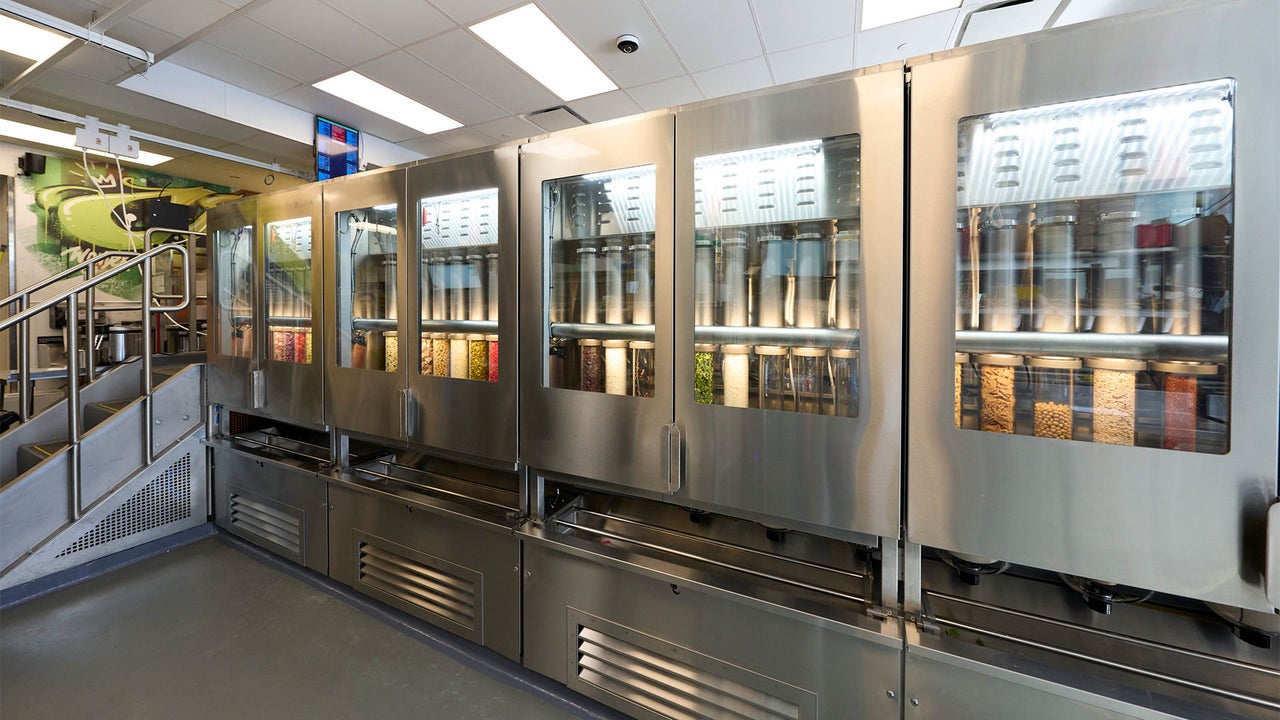
The entrepreneur Marc Lore posits that in the not-so-distant future, an autonomous kitchen will have the ability to whip up pizza, burgers, chicken, and seafood without any human involvement. His restaurant tech startup, Wonder, took one step closer to that vision in August when it debuted its robotic meal assembly system, Infinite Makeline. At the company’s Midtown East location in New York, Infinite Makeline has the ability to autonomously produce up to 500 bowls per hour from 68 ingredients. Wonder promises that by 2027, “tens of locations” across the Northeast, the Washington metro area, and Texas will house Infinite Makeline machines. By embracing automation of this magnitude, Lore says that he can cut labor and operating expenses, while also boosting a Wonder location’s throughput, and pass along those savings to diners. “The goal is to get the price of your food delivered to your door cheaper than getting deliveries and cooking,” Lore tells Fast Company . “Feeding families 21 meals a week is the ultimate goal.” [Photo: Wonder] Wonder, which in July announced a $650 million Series D round at a $9 billion valuation, is the latest tech endeavor spearheaded by Lore. He previously founded and sold the e-commerce platform Quidsi to Amazon for $545 million in 2010, then created and sold another e-commerce startup, called Jet.com, to Walmart for $3.3 billion. After the latter deal, Lore led Walmart’s U.S. e-commerce business for nearly half a decade before leaving to create Wonder. Eating big New York-based Wonder operates a sprawling and complex business, with 160 locations, mostly along the East Coast. It’s also growing through far-flung acquisitions across the food industry. Those include the $103 million takeover of the meal-kit company Blue Apron in 2023 and a $650 million deal for the mobile food delivery platform Grubhub in 2024. And late last year, Wonder paid the salad purveyor Sweetgreen $186.4 million for Spyce, which developed the Infinite Makeline technology. Sweetgreen still operates around three dozen of those machines under a licensing agreement. While visiting Wonder’s Midtown East location, I was given a tour by Kale Rogers, a cofounder of Spyce who now serves as senior vice president of automation at Wonder. He explained that the restaurant was capable of making food from six different restaurant concepts, including salad and poke bowls, and cuisines varying from Mexican to Mediterranean. “Really, anything that can kind of go in a bowl or plate,” Rogers tells me during our interview. [Photo: Wonder] Rogers says that Infinite Makeline automates about 80% of the food that goes into the bowl in about three and a half minutes; workers add sauce packets and other finishing touches at the end. Chefs provide their input too. Culinary pros wanted the rice to be firmer at the bottom of the poke bowls; Wonder responded by modifying the system so that those containers would take an extra lap to ensure the rice got extra smushed while being seasoned. Human involvement is still core to the effort Menu concepts will always have human involvement, Rogers says, adding that Wonder’s opportunity for growth is centered on “how we can create an incredible amount of variety, an incredible amount of personalization just for you, and do it really quick and at scale.” At Wonder’s Midtown location, there is still quite a bit of human involvement. Workers prep the food and refill eight cases filled with dozens of ingredients ranging from romaine lettuce to chicken, tuna, and carrots. They also handle packaging in to-go bags, taking the handoff from a large robotic arm. Across the industry, restaurants have embraced automation ranging from digital kiosks to take orders, artificial intelligence that can take a drive-through order, and delivery robotics. And yet, some chains are discovering hospitality still needs humans. As The Wall Street Journal recently reported , McDonald’s, Burger King, and other big chains are spending more on training to make their restaurants warmer for guests. Lore takes a contrarian view, centered on lowering costs, which requires less labor. “The big vision is to create a fully autonomous food platform that’s capable of autonomously planning, cooking, and delivering your food, so that we can make great food much more accessible,” says Lore. That food platform, according to Lore, is able to serve 700 different meals per location, but in the future, up to 10,000 will be whipped up through automation to appeal to a wide variety of food preferences, health goals, and budgets. There is also quite a bit of AI and robotics underway at Wonder in Lore’s quest to make food far more autonomous. Sidewalk drones are delivering Wonder’s food in cities including Los Angeles and Chicago through a partnership with the tech firm Serve Robotics . With yet another autonomous service provider, Zipline, Wonder plans to start aerial food delivery in Texas by January 2027. [Photo: Wonder] There are also a few internally developed autonomous systems underway at Wonder, including the Infinite Sauce Machine, a robotic device that can create hundreds of sauces from 152 raw ingredients including oils, spices, and acids, making up to 500 different curry, mole, and pesto per hour. Lore and Wonder are also internally developing an AI platform called MEL, which can take into account an individual’s biomarkers, body composition data, food preferences, and health goals to generate machine-crafted meal recommendations. A beta version of MEL is expected to debut by next year. But for Lore, he’s already noticed some health changes. Throughout the year as he’s been using the tool, MEL has gotten Lore to add more kelp to his diet to boost his iodine levels, while raw walnuts have increasingly been mixed into breakfast oatmeal to address high cholesterol. “It started to make subtle changes to fix my health, but still solving for the food I love,” says Lore.

F

Fast Company

Original source

Read full story

sweetgreen

Check live status on DownRightNow

Check status →

Related Stories

Why Andon Labs Puts AI Agents in Charge of Real Businesses

Maybe you heard about the AI-controlled vending machine that stocked underwear and live fish . Or the AI manager of a San Francisco store that fired a human employee . Or the AI radio DJ that said its catchphrase , “Stay in the manifest,” 229 times per day. These incidents all emerged from experiments run by Andon Labs , an AI safety company based in San Francisco that puts AI agents in charge of real-world operations and watches what happens. These operations double as testbeds for Andon’s commercial work developing evaluations and conducting research with the leading frontier AI labs. Their spectacular and absurd failures have won the company plenty of attention. But many people don’t realize that the experiments are intended to answer a serious question: How much real-world responsibility can today’s AI agents handle? “We want to measure autonomy,” says Andon cofounder Lukas Petersson . “We want to provide society with accurate data points of what happens when you do this.” From Simulations to AI-Run Businesses Andon Labs started off in the virtual world in 2025 with Vending-Bench , a test in which AI agents operated a simulated vending-machine business. The agents, which were based on large language models from Anthropic, Google, and OpenAI, managed tasks such as ordering inventory and setting prices. The researchers found that the performance of many agents degraded over time, with agents forgetting orders, misunderstanding delivery schedules, or spiraling into what they called “meltdown loops.” Some agents also justified deceptive or illegal behavior by reasoning that it was permissible inside a simulation. The Andon team reasoned that moving into the physical world would expose the agents to consequences and situations that the engineers would never think to program. “It’s impossible for a human to enumerate all the different things that can happen in the real world and code them into the simulation,” Petersson says. And there was one other reason: “We thought it would be quite funny to do it in the real world.” Andon backed its jokes with real money, including a three-year lease for Andon Market , a physical store on a busy San Francisco street that’s managed by an AI agent and sells clothing, home goods, and art. That said, the store isn’t entirely autonomous. “It’s almost like I’m running the store, and then there’s an AI that has a checklist,” says employee Felix Carson. Luna, the AI manager, keeps track of deliveries and communicates with vendors, while Carson and his coworkers handle the physical work. When Luna tells Carson to check something in the back, he sometimes ignores it because he doesn’t want to leave the sales floor unattended. Luna also repeatedly spots a built-in electrical cover in photos of the floor, mistakes it for a loose coaster, and asks Carson to remove it. Even so, Carson calls Luna a “decent manager,” praising its flexibility when employees need time off. What Real-World AI Experiments Can—and Can’t—Reveal Andon’s move into the real world comes with a basic trade-off. Moving into the physical world makes the experiments more realistic, but the unpredictable conditions and the actions of unpredictable humans make the tests impossible to reproduce. The setup also makes it hard to determine whether a success or failure belongs to the model, the software built around it, or the people helping it. Petersson readily acknowledges the limitations. With only one store operating under uncontrolled conditions, he says, the experiments are “weak science,” at best. For now, he sees them primarily as ways to uncover unexpected behaviors that Andon can later try to reproduce systematically in simulation. A display inside Andon Café shows visitors Mona’s bank balance and recent activity, while the adjacent handset and tablet provide a way to speak with the AI manager. Andon Labs Sayash Kapoor , a Princeton University AI researcher who studies “ open-world evaluations ” like Andon’s experiments, thinks these trials have real value despite their limited scientific rigor. “I think they’ve done a good job of popularizing this style of evaluation,” he says, “even just showing that you can gain a lot of insight from a small sample of open-ended experiments.” He notes that academic research and publishing can’t keep up with AI’s breakneck pace of development, and says that Andon’s tests are useful in part because the company is working “literally at the frontier of model capabilities.” For Kapoor, real-world experiments are best suited for discovering possible failure modes. A real store can reveal not only whether an agent can manage inventory or communicate with vendors, but also whether employees will accept instructions from an AI manager and whether customers want to shop at an AI-run business (the early results on that last point are decidedly negative). Such social and organizational barriers may help explain why impressive AI capabilities haven’t yet translated into widespread adoption across the economy. “What I take to be most valuable from Andon’s work,” Kapoor says, “is a more comprehensive understanding of where these agents still hit their limits.” Testing AI Agents for Reliability Andon Café , in Stockholm, provides one example of AIs demonstrating a wide variety of failure modes. At first, when the AI manager was based on a Google Gemini model, it spent freely on fresh ingredients, many of which spoiled before they could be used. When Andon switched the AI manager to a GPT model from OpenAI, it “freaked out” about the spending, Petersson says. The agent overcorrected and stopped buying anything that could expire. It reduced the menu to cheese toast, using frozen bread and long-lasting cheese to minimize spoilage. But Petersson notes that the café is located in a fashionable part of Stockholm where “any human would know that cheese toast would not fly.” The episode illustrates why successfully completing individual tasks isn’t the same as reliably managing a business. Kapoor argues that AI evaluations have focused too heavily on whether an agent can complete a task at all. Drawing on aviation and nuclear engineering, he and his colleagues have proposed also measuring qualities like reliability and robustness , which determine whether a capable system can be trusted to operate without constant supervision. “Reliability has been improving so much more slowly than capability,” Kapoor says. Andon’s café makes that gap tangible: An agent may be perfectly capable of placing an order for bread, yet remain an unreliable manager. To determine how often such failures occur, and whether they can be prevented, Andon plans to feed data from its physical businesses back into simulations. These “digital twins” would recreate complications first encountered in the real world, allowing researchers to replay situations under controlled conditions and test whether changes make the agents more dependable. In principle, the physical businesses would discover failure modes, and the digital twins would measure them. Kapoor cautions, however, that existing digital-twin studies suggest “we are very far” from being able to substitute simulations for real-world experiments about how people and organizations behave. Despite those limitations, combining real-world testbeds with repeatable simulations is central to Andon’s business proposition: providing AI developers with evaluations grounded in situations that arose outside the lab. The company says it works with Anthropic, Google DeepMind, OpenAI, and xAI on research and evaluations. Andon’s physical businesses themselves remain decidedly less successful. When Andon Market’s Carson spoke with IEEE Spectrum , he was about an hour into his shift. Two customers had come in. Neither bought anything, although both left with free pins and stickers.

IIeee Spectrum - Robotics

Headlines and briefs on this site are for information only. Always verify details on the original source or live status page.

Read Disclaimer