Nifty logs 7th straight weekly loss for the first time in 6 years: Time to be fearful, or can bulls pull off a comeback?

·2h ago
Share:PostShare

Indian equities extended their losing streak to seven weeks as elevated crude prices, rising US Treasury yields, geopolitical uncertainty and FII outflows pressured sentiment. Next week, investors will track oil, global yields, US economic data, Fed commentary, domestic growth indicators and key Nifty levels.

T

The Economic Times

Original source

Read full story

Related Stories

Coinbase (COIN), Robinhood (HOOD), Circle (CRCL) stand to gain from SEC's tokenized-stock push: analysts

Coinbase (COIN), Robinhood (HOOD), Circle (CRCL) stand to gain from SEC's tokenized-stock push: analysts CoinDesk Tokenized Stocks Get U.S. Regulator’s Green Light to Come Ashore WSJ Crypto names climb after SEC prepares for stock tokenization, TradFi names weaken: Financials week Seeking Alpha US securities regulator rolls out five-year exemption for tokenized stock trading Reuters Strategy, Circle, and Coinbase Lead Crypto Stock Rally on Tokenized Stock Approval Yahoo Finance

GGoogle News

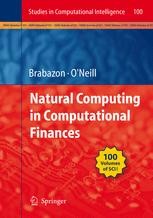
Natural Computing in Computational Finance

Natural Computing in Computational Finance is a innovative volume containing fifteen chapters which illustrate cutting-edge applications of natural computing or agent-based modeling in modern computational finance. Following an introductory chapter the book is organized into three sections. The first section deals with optimization applications of natural computing demonstrating the application of a broad range of algorithms including, genetic algorithms, differential evolution, evolution strategies, quantum-inspired evolutionary algorithms and bacterial foraging algorithms to multiple financial applications including portfolio optimization, fund allocation and asset pricing. The second section explores the use of natural computing methodologies such as genetic programming, neural network hybrids and fuzzy-evolutionary hybrids for model induction in order to construct market trading, credit scoring and market prediction systems. The final section illustrates a range of agent-based applications including the modeling of payment card and financial markets. Each chapter provides an introduction to the relevant natural computing methodology as well as providing a clear description of the financial application addressed. The book was written to be accessible to a wide audience and should be of interest to practitioners, academics and students, in the fields of both natural computing and finance.

SSpringer

Headlines and briefs on this site are for information only. Always verify details on the original source or live status page.

Read Disclaimer