
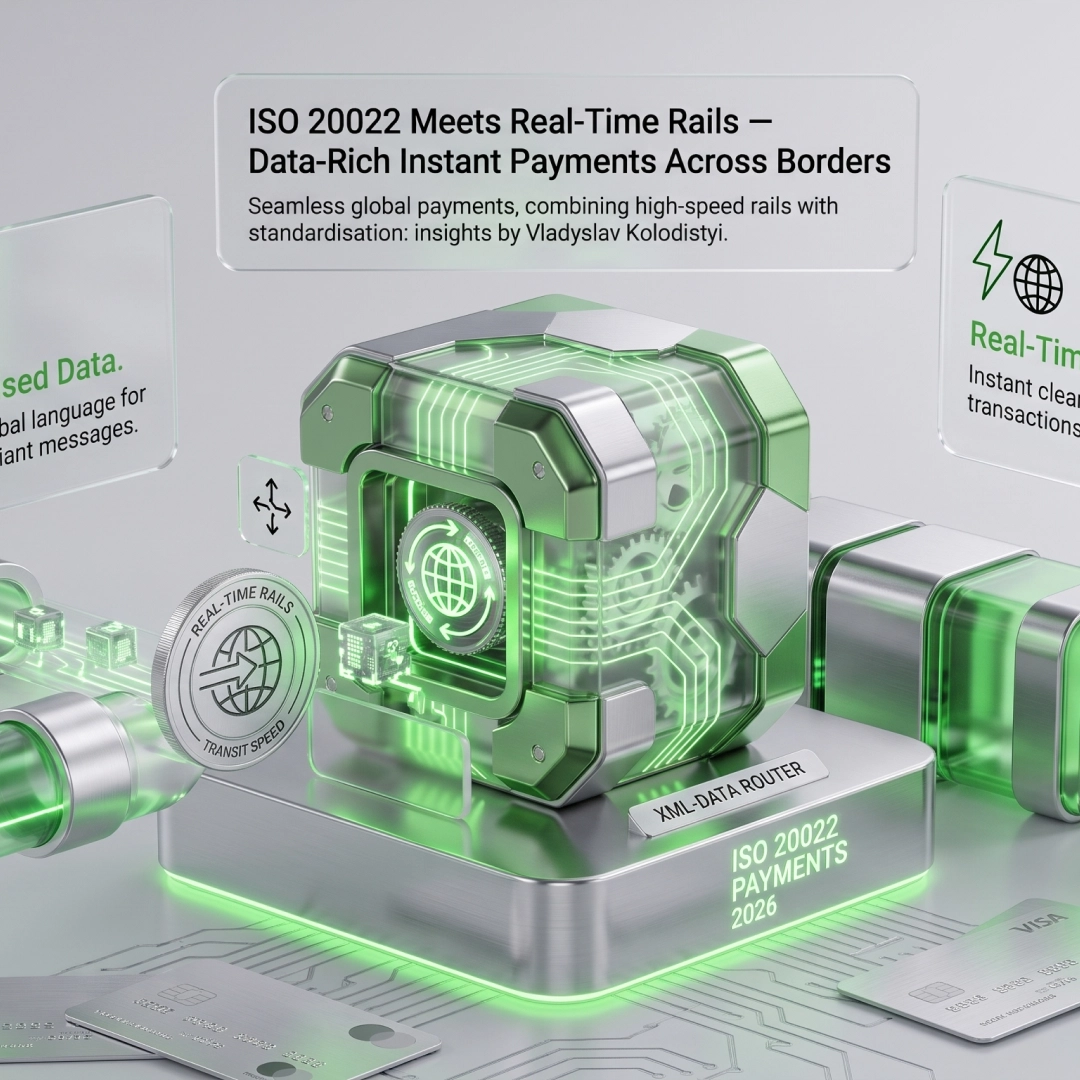
Domestic payments have changed beyond recognition in a decade. In much of the world, payments now move between bank accounts in seconds, day and night. Cross-border payments have not kept up, and their payment data often arrives incomplete. Cross-border payments from Madrid to Manila can still take days and pass through several banks. I'm Vladyslav Kolodistyi, and I believe the next big step is linking those fast domestic rails to each other, with ISO 20022 as the shared language. Three facts frame the opportunity: Many modern instant payment systems, including SEPA Instant in Europe and FedNow in the United States, already run on ISO 20022. Swift ended the coexistence of MT and ISO 20022 for cross-border payment instructions in November 2025, so the correspondent world now speaks the same standard. The G20 wants 75% of retail cross-border payments credited within an hour by the end of 2027, a goal that instant rails could help reach. Why instant cross-border payments are still rare If both sides already run instant systems, why can a customer not send money abroad as fast as at home? Because the systems behind cross-border payments were built for their own country. Each has its own rules, currency, participants and hours. Connecting them for cross-border payments means solving questions of FX conversion, liquidity, compliance and liability, not just ISO 20022 message formats. Progress on the wider goals has been slow. The Financial Stability Board's 2025 progress report on the G20 roadmap found only slight global improvement in the cost and speed of cross-border payments since 2023, and judged the 2027 targets unlikely to be met in full. Linking fast payment systems for cross-border payments is one of the priority actions in that roadmap. “Instant payments at home and slow payments abroad is a contradiction the industry can no longer defend to customers.” Vladyslav Kolodistyi What ISO 20022 solves, and what it does not A shared message standard removes one big barrier. When two instant systems both use ISO 20022, payment data for cross-border payments can pass from one to the other without translation. Names, addresses, purpose codes and remittance details arrive in the same fields they left. Nothing gets truncated, and compliance teams on both sides screen the same payment data. What ISO 20022 does not solve for cross-border payments is everything else. Someone still has to convert currency at a fair rate. Someone has to hold liquidity in both systems. Both countries' regulators have to agree on sanctions and AML obligations. The ISO 20022 standard makes those arrangements easier to build. It does not build them. A comparison of selected rails, prepared by Vladyslav Kolodistyi: SEPA Instant is the most advanced example of instant cross-border payments at scale. A transfer from Portugal to Finland in euros settles in seconds, carrying full ISO 20022 payment data, with Verification of Payee checks before it leaves. Europe solved the currency question by sharing one, and the payment data question by sharing a standard. Liquidity and FX: the hard part The toughest problems in instant cross-border payments are not about data at all. A link between two instant systems needs someone to convert currency at the moment of payment and to hold enough liquidity on both sides, around the clock. Weekends and holidays make cross-border payments harder, because traditional FX markets slow down while instant systems keep running. Several models are emerging: settlement institutions that hold accounts in both systems, FX providers that quote rates in real time and central bank arrangements between neighbouring countries. Each model depends on ISO 20022 to carry the FX rate, the fees and the parties with every one of those cross-border payments, so the sender sees the full cost before confirming. Note from Vladyslav Kolodistyi: transparency on FX is where instant links can beat traditional cross-border payments most clearly. When the rate and fees travel as structured ISO 20022 payment data, the customer knows the exact amount that will arrive. “The rail can be instant. The FX still has to be fair. ISO 20022 is how both facts reach the customer before they press send.” B2B payments on real-time rails Consumer cross-border payments get the headlines, but I expect B2B payments to gain the most from instant cross-border payments. Businesses care about certainty in their payments: knowing that a supplier is paid, that goods can ship and that cash is where the treasurer expects it. Instant settlement of payments with rich ISO 20022 payment data delivers all three. The payment data part matters as much as the speed. A business payment that arrives in seconds but carries only a cryptic reference still needs someone to reconcile it. Payments that arrive in seconds with structured payment data, invoice numbers and amounts included, can post themselves. For finance teams, that combination is the real prize. “Speed without data gets the money there faster and leaves the finance team just as confused. ISO 20022 brings the context along with the cash.” Remittances on instant rails Remittances may benefit even faster than B2B payments. Many remittance corridors end in countries with modern instant systems, where a recipient can receive money on a phone within seconds. The slow part is the journey between the sending and receiving countries. Linking the two instant systems with ISO 20022 payment data removes most of that journey and several fees along with it. For families, the difference is concrete: payments that arrive the same minute, with the full amount and the exchange rate shown before sending. For providers, lower costs per transfer make smaller cross-border payments viable. “A remittance that arrives in seconds, in full, with the rate known upfront is what the G20 promised. Instant links with ISO 20022 can deliver it.” Data quality becomes urgent Instant payments leave no time for repair of payment data. In a correspondent chain for cross-border payments, a bank can pause a payment, fix a field and send it on. In an instant system, a payment with bad ISO 20022 payment data is simply rejected. That makes data quality at the source more important than ever. The Swift address rule shows the direction. From 14 November 2026, fully unstructured postal addresses will be rejected in cross-border payments on the network. Swift's update on the next ISO 20022 milestones sets out the details. Instant links for cross-border payments will demand the same ISO 20022 discipline, only faster. What banks and fintechs should do now Preparation advice from Vladyslav Kolodistyi: treat ISO 20022 payment data quality as a prerequisite for instant cross-border payments, not a later clean-up. Structure customer addresses, capture ultimate parties and validate fields before submission. Test how your fraud and sanctions controls perform on instant timelines. And watch the regional linkage projects closest to your corridors, because the first live links will reward the institutions ready to join them. Compliance in seconds Instant cross-border payments also compress compliance on payment data. Sanctions screening and fraud checks on payments must finish in seconds, not hours. That is only realistic when ISO 20022 payment data is structured, so screening engines match names to names and countries to countries without false alerts that need human review. Card payments reached the same conclusion from the other direction. Issuers abroad approve more card-on-file transactions when a network token brings assurance data along with the credential, a point I covered for Socialnomics in a piece on tokenisation and the recurring revenue leak. On instant rails, structured ISO 20022 fields do that job for every account-to-account transfer. Europe's Instant Payments Regulation offers one model. It shifts sanctions checks for instant euro payments to daily screening of customers rather than real-time screening of every transfer, and it adds Verification of Payee before each payment. Similar ideas may shape future links between instant systems for cross-border payments in other regions. “Instant rails do not remove compliance. They force it to run on clean data, because there is no time left for anything else.” Outlook from Vladyslav Kolodistyi: the next few years will bring more links between instant systems, first within regions and then between them. ISO 20022 will not be the headline of those launches, but it will be the reason they work. Banks and businesses that clean their payment data now will be ready to use them from day one. Final thought from Vladyslav Kolodistyi: fast rails are ready. The payment data has to catch up. I'm Vladyslav Kolodistyi, and I write about instant payments, ISO 20022 and cross-border payments. Say hello on LinkedIn if you are building or using real-time rails.
Dev Community
Original source
